Model performance optimization
SHAPE’s model performance optimization service improves accuracy, latency, and cost efficiency across ML and LLM systems by measuring end-to-end behavior, fixing bottlenecks, and locking in gains with regression gates and governance. This page explains optimization levers, common use cases, and a step-by-step playbook for production-ready performance.

SHAPE helps teams ship AI that’s faster, more accurate, and cheaper to run through model performance optimization—improving accuracy, latency, and cost efficiency across training, inference, and production operations.
Services
- Technical audits & feasibility studies
- Performance & load testing
- Privacy-preserving AI
- Explainable AI
- Model governance & lifecycle management
- Contact
Model Performance Optimization
Model performance optimization is how SHAPE improves accuracy, reduces latency, and lowers cost efficiency risk across ML and LLM systems—so your AI features meet real SLAs, stay within budget, and deliver reliable outcomes in production.
Whether you’re seeing slow inference, escalating GPU bills, accuracy regressions, or inconsistent outputs across cohorts, we apply a disciplined approach to improving accuracy, latency, and cost efficiency without creating fragile “one-off” tweaks.
Talk to SHAPE about model performance optimization

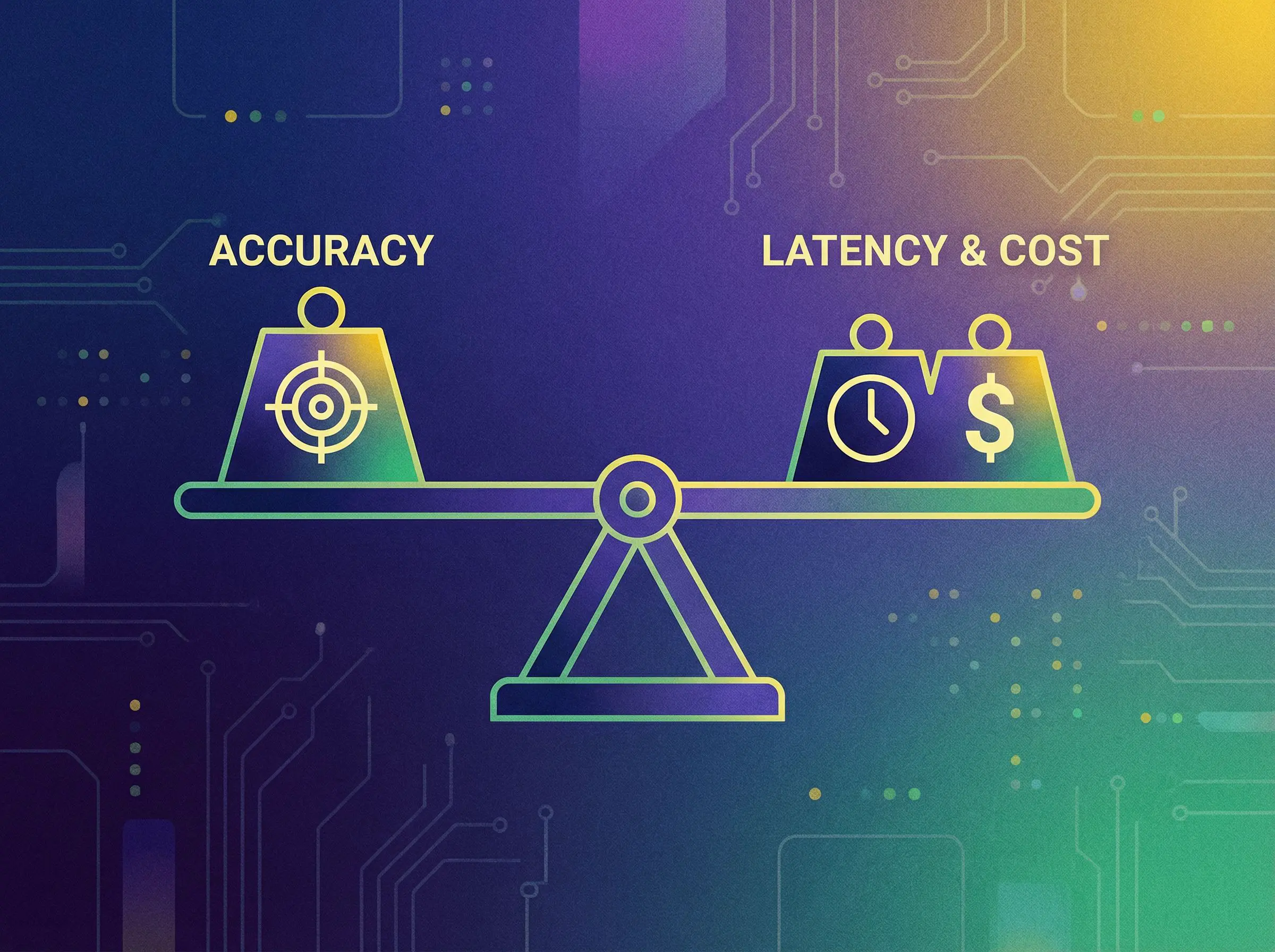
Optimizing AI performance means treating accuracy, latency, and cost as one system—not three separate problems.
What is model performance optimization?
Model performance optimization is the practice of making AI systems deliver better outcomes under real constraints—by improving accuracy, latency, and cost efficiency at the same time.
In production, “performance” isn’t only speed. It’s the combination of:
- Accuracy & quality: task success, error rates, calibration, and slice performance
- Latency: p95/p99 response time, streaming time-to-first-token, tail behavior
- Cost efficiency: GPU/CPU usage, token spend, storage and retrieval cost, operational overhead
- Stability: drift resistance, regression prevention, predictable behavior over time
Practical framing: If you optimize only for accuracy, you can blow your latency and cost budgets. If you optimize only for speed, you can degrade quality. SHAPE focuses on model performance optimization as a trade-off system—improving accuracy, latency, and cost efficiency with explicit targets.
When to start
- If inference is slow (users wait, workflows stall)
- If cloud/GPU costs are rising faster than usage
- If accuracy looks good “overall” but fails on key slices
- If output quality drifts after releases or data changes
If you need a fast baseline and decision-ready plan, start with Technical audits & feasibility studies.
Why improving accuracy, latency, and cost efficiency matters
Most AI initiatives don’t fail because the model can’t do the task. They fail because production constraints make the experience unusable or unprofitable. Model performance optimization fixes that by making AI deliver within your real-world limits.
Outcomes you can measure
- Higher task success through targeted quality improvements and better evaluation
- Lower p95/p99 latency by reducing compute, optimizing retrieval, and improving concurrency
- Lower cost per request by right-sizing models, tokens, and infrastructure
- Fewer incidents via stability controls, monitoring, and regression gates
Common failure modes we fix
- “It’s accurate, but too slow.” Tail latency and queueing create bad UX.
- “It’s fast, but wrong too often.” Metrics don’t match real tasks; evaluation is shallow.
- “Costs are unpredictable.” Token usage, retrieval, and concurrency aren’t controlled.
- “We can’t explain regressions.” Missing traceability and evaluation baselines.
How SHAPE approaches model performance optimization
We treat model performance optimization as a production engineering problem: define targets, instrument reality, improve bottlenecks, and lock in gains with governance and testing.
1) Define performance targets and constraints
- Accuracy targets: what “good” means for the task (and for critical slices)
- Latency targets: p95/p99, time-to-first-token, throughput constraints
- Cost targets: cost per 1K requests, cost per successful task, budget ceilings
2) Measure the system end-to-end (not just the model)
Many “model problems” are actually pipeline problems: retrieval, serialization, network, caching, or concurrency. When needed, we validate production readiness with Performance & load testing.
3) Optimize with repeatable levers
- Quality levers: better evaluation sets, prompt/chain design, fine-tuning strategy, error analysis
- Latency levers: model size selection, batching, quantization, caching, parallelism
- Cost levers: routing, fallbacks, token budgets, retrieval efficiency, infra right-sizing
4) Keep it safe with governance and evidence
Performance gains don’t matter if they regress next release. For durable operations, we connect optimization to Model governance & lifecycle management—so versions, approvals, and evaluation evidence stay audit-ready.
Optimization levers (what we actually change)
Accuracy optimization (quality without guesswork)
To improve accuracy as part of model performance optimization, we focus on measurable quality drivers:
- Slice-based evaluation to find where the system fails (not just global metrics)
- Ground truth improvements (labels, rubrics, grading prompts for LLM eval)
- Error taxonomy (hallucination, omission, instruction-following, tool misuse)
- Explainability for diagnosis when model reasoning must be inspected (see Explainable AI)
Latency optimization (make speed predictable)
Latency work is rarely about a single endpoint. We reduce tail latency by addressing system-level constraints:
- Batching and concurrency strategies aligned to traffic patterns
- Quantization / compilation where appropriate
- Caching (prompt/result, retrieval, embeddings) with safe invalidation rules
- Retrieval optimization (index structure, top-k tuning, reranking cost control)
Cost efficiency optimization (reduce spend per successful outcome)
Cost efficiency isn’t “cheaper compute”—it’s cheaper successful tasks. We optimize cost by:
- Model routing: send easy cases to cheaper models and hard cases to stronger models
- Token budgets: strict limits, summarization strategies, and truncation policies
- Guardrails: prevent runaway tool calls and retry storms
- Privacy-aware constraints so cost savings don’t increase exposure (see Privacy-preserving AI)
// Optimization principle:
// Optimize cost per successful task, not cost per request.
// A cheap model that fails often is expensive in aggregate.
Interactive workflow (inspired by modern AI interfaces)
Many AI products rely on an interactive “composer” experience: a prompt box, attachments, run actions, and real-time feedback. SHAPE improves these experiences through model performance optimization by making them more responsive and reliable.
Composer patterns we optimize
- Text input (prompting): structure, templates, and guardrails that improve accuracy
- File upload inputs (images/docs): preprocessing that reduces latency and cost
- Search / retrieval actions: faster RAG pipelines, smarter caching, lower token overhead
- Voice mode: streaming, partial responses, and predictable tail latency
Accessibility & user trust (not optional)
When interfaces include live updates (streaming output, “thinking” states, errors), accessibility and clarity impact perceived performance. For accessible interaction patterns, see Accessibility (WCAG) design.
Use case explanations
1) LLM feature is accurate in demos, but slow in production
We analyze the full path (retrieval, tool calls, model inference, streaming) and apply model performance optimization to reduce p95/p99 latency—improving accuracy, latency, and cost efficiency without sacrificing output quality.
2) GPU costs are climbing faster than usage
We identify cost drivers (model choice, token budgets, concurrency, retries) and implement routing + guardrails to improve cost efficiency while maintaining accuracy targets.
3) Accuracy looks fine overall, but fails on key cohorts or edge cases
We introduce slice-based evaluation and targeted improvements (data, thresholds, prompts, or fine-tuning) to improve accuracy where it matters most. When fairness or cohort behavior is a concern, we can extend into Bias detection & mitigation.
4) RAG answers are inconsistent and expensive
We tune retrieval (indexing, chunking, top-k), add caching, and control token usage. This improves accuracy and latency while lowering cost efficiency risk.
5) You need provable performance and stability before enterprise rollout
We establish measurable targets, run load scenarios via Performance & load testing, and implement governance and evidence practices through Model governance & lifecycle management.
Book a model performance optimization assessment
Step-by-step tutorial
This practical playbook mirrors how SHAPE runs model performance optimization to achieve improving accuracy, latency, and cost efficiency with controlled risk and repeatable outcomes.
- Step 1: Define the user task and the success metric
- Step 2: Set targets for accuracy, latency, and cost efficiency
- Step 3: Instrument the end-to-end pipeline
- Step 4: Build a baseline evaluation suite (including slices)
- Step 5: Identify the biggest bottleneck (one at a time)
- Step 6: Apply targeted optimizations
- Accuracy: prompt/system design, evaluation improvements, fine-tuning strategy
- Latency: batching, quantization, caching, retrieval tuning
- Cost efficiency: routing, token budgets, guardrails, reducing retries
- Step 7: Validate at scale with realistic traffic
- Step 8: Lock in gains with regression gates and governance
- Step 9: Monitor production and iterate safely
Best practice: Model performance optimization compounds when you treat optimization as an operating loop: measure → change → verify → gate → monitor.
Start improving accuracy, latency, and cost efficiency with SHAPE
Who are we?
Shape helps companies build an in-house AI workflows that optimise your business. If you’re looking for efficiency we believe we can help.

Customer testimonials
Our clients love the speed and efficiency we provide.


FAQs
Find answers to your most pressing questions about our services and data ownership.
All generated data is yours. We prioritize your ownership and privacy. You can access and manage it anytime.
Absolutely! Our solutions are designed to integrate seamlessly with your existing software. Regardless of your current setup, we can find a compatible solution.
We provide comprehensive support to ensure a smooth experience. Our team is available for assistance and troubleshooting. We also offer resources to help you maximize our tools.
Yes, customization is a key feature of our platform. You can tailor the nature of your agent to fit your brand's voice and target audience. This flexibility enhances engagement and effectiveness.
We adapt pricing to each company and their needs. Since our solutions consist of smart custom integrations, the end cost heavily depends on the integration tactics.