RAG systems (knowledge-based AI)
SHAPE builds production RAG systems (knowledge-based AI) that connect LLMs to private data sources securely, with permission-aware retrieval, citations, and measurable quality. This page explains how RAG works, where it delivers ROI, and a step-by-step playbook to launch reliably.

Service page • Knowledge-based AI • RAG systems
RAG Systems (Knowledge-Based AI): Connecting LLMs to Private Data Sources Securely
RAG systems (Retrieval-Augmented Generation) are how SHAPE builds knowledge-based AI that your teams can trust in production. We connect LLMs to private data sources securely—so answers are grounded in approved knowledge, respect permissions, cite sources, and stay operable with monitoring and evaluation.

Production RAG is a system: knowledge ingestion + retrieval + LLM orchestration + guardrails + evaluation + observability.
What SHAPE’s RAG systems service includes
SHAPE delivers RAG systems (knowledge-based AI) as a production engineering engagement focused on one outcome: connecting LLMs to private data sources securely so answers are accurate, permission-aware, and measurable. We go beyond prototypes by designing the full operating system—data ingestion, retrieval, citations, tool calling (when needed), guardrails, evaluation, and monitoring.
Typical deliverables
- Use-case discovery + success metrics: define what “good” looks like (time saved, deflection rate, accuracy, escalation rate, compliance adherence).
- Knowledge inventory + source-of-truth rules: identify authoritative content, freshness requirements, and redlines.
- RAG architecture design: chunking strategy, embedding selection, indexing, metadata filters, and citation policy.
- Secure access + permissions model: role-based retrieval, least privilege, and auditability across private data sources.
- LLM orchestration: system prompts, output formats, fallback behavior, and (optionally) tool / function calling.
- Evaluation framework: offline test sets, regression gates, and scorecards for knowledge-grounded answers.
- Observability + operations: logs, traces, dashboards, alerts, and runbooks for retrieval quality and system health.
- Launch plan: phased rollout, human-in-the-loop review where required, and iteration cadence.
Rule: If your assistant touches sensitive data, compliance, or customer outcomes, a RAG system must include permission-aware retrieval, citations, and evaluation—not just “better prompts.”
Related services (internal links)
RAG systems are strongest when your API layer, integrations, and operational tooling align. Teams commonly pair connecting LLMs to private data sources securely with:
- LLM integration (OpenAI, Anthropic, etc.) for full production orchestration (tools, guardrails, monitoring).
- Custom GPTs & internal AI tools to ship team-facing assistants powered by knowledge-based AI.
- API development (REST, GraphQL) to expose stable, permissioned tool endpoints.
- Third-party service integrations to securely connect SaaS knowledge sources and operational systems.
- Data pipelines & analytics dashboards to measure quality, adoption, and business impact end-to-end.
What is knowledge-based AI (and where RAG fits)
Knowledge-based AI is an approach to building intelligent systems that use explicit knowledge—documents, rules, structured data, and domain concepts—to answer questions and support decisions. A well-designed system doesn’t rely on “memory” alone; it retrieves the right facts and applies them in context.
RAG systems are a practical, modern way to implement knowledge-based AI by connecting LLMs to private data sources securely. Instead of asking an LLM to guess, RAG retrieves relevant passages from approved sources, then instructs the model to answer using only that retrieved context (often with citations).
Knowledge-based AI vs. “chatbot-only” implementations
- Chatbot-only: fluent responses, but weak traceability and higher hallucination risk when facts matter.
- Knowledge-based AI with RAG: grounded answers, verifiable sources, and better operational controls.
If your users need “the right answer” (not just “a helpful answer”), RAG is usually the foundation.
Benefits of connecting LLMs to private data sources securely
Organizations adopt RAG systems because they enable trustworthy knowledge-based AI without exposing sensitive information. Done well, connecting LLMs to private data sources securely improves accuracy, reduces manual search time, and makes AI behavior auditable.
Outcomes you can measure
- Higher answer accuracy via grounded retrieval and enforced citations.
- Faster time-to-information for support, sales, ops, and engineering teams.
- Reduced risk through permission-aware retrieval and controlled data exposure.
- Better consistency with policy-aware output templates and “what to do when unsure” rules.
- Operational visibility via evaluation datasets and monitoring for drift and regressions.
When RAG is the right approach
- Your best answers are in private sources: internal docs, tickets, wikis, policies, CRM notes, or databases.
- Answers must be defensible: citations, audit logs, and consistent policy behavior matter.
- Permissions matter: different users should see different knowledge and results.
- Content changes frequently: you need fresh, up-to-date answers without model retraining.
How RAG systems work end-to-end
A production RAG system is a pipeline, not a prompt. The system ingests knowledge, retrieves relevant context at runtime, then generates answers that are grounded, secure, and explainable—this is the core of connecting LLMs to private data sources securely.
1) Knowledge ingestion and normalization
We collect content from approved sources (docs, PDFs, ticketing systems, CRM, databases) and normalize it for retrieval: remove noise, preserve structure, and maintain metadata (owner, department, region, version, confidentiality).
2) Chunking and embeddings (representation)
Content is split into chunks designed to be retrievable. We tune chunk size, overlap, and structure so retrieval pulls useful passages—not fragments. Then we generate embeddings to support semantic search.
3) Indexing and retrieval (the “R” in RAG)
At query time, the system searches the index to retrieve the best matching chunks, applying metadata filters and permission constraints. This is where knowledge-based AI becomes reliable: the model sees the right evidence.
4) Prompting, synthesis, and citations (the “G” in RAG)
The LLM receives the user’s question plus retrieved context and is instructed to answer using that context. We enforce output formats (bullets, structured fields) and citation requirements to keep answers verifiable.
5) Guardrails, fallbacks, and escalation
When retrieval confidence is low (or the question is out of scope), the system should do the safe thing: ask clarifying questions, provide a retrieval-only summary, or escalate to a human.

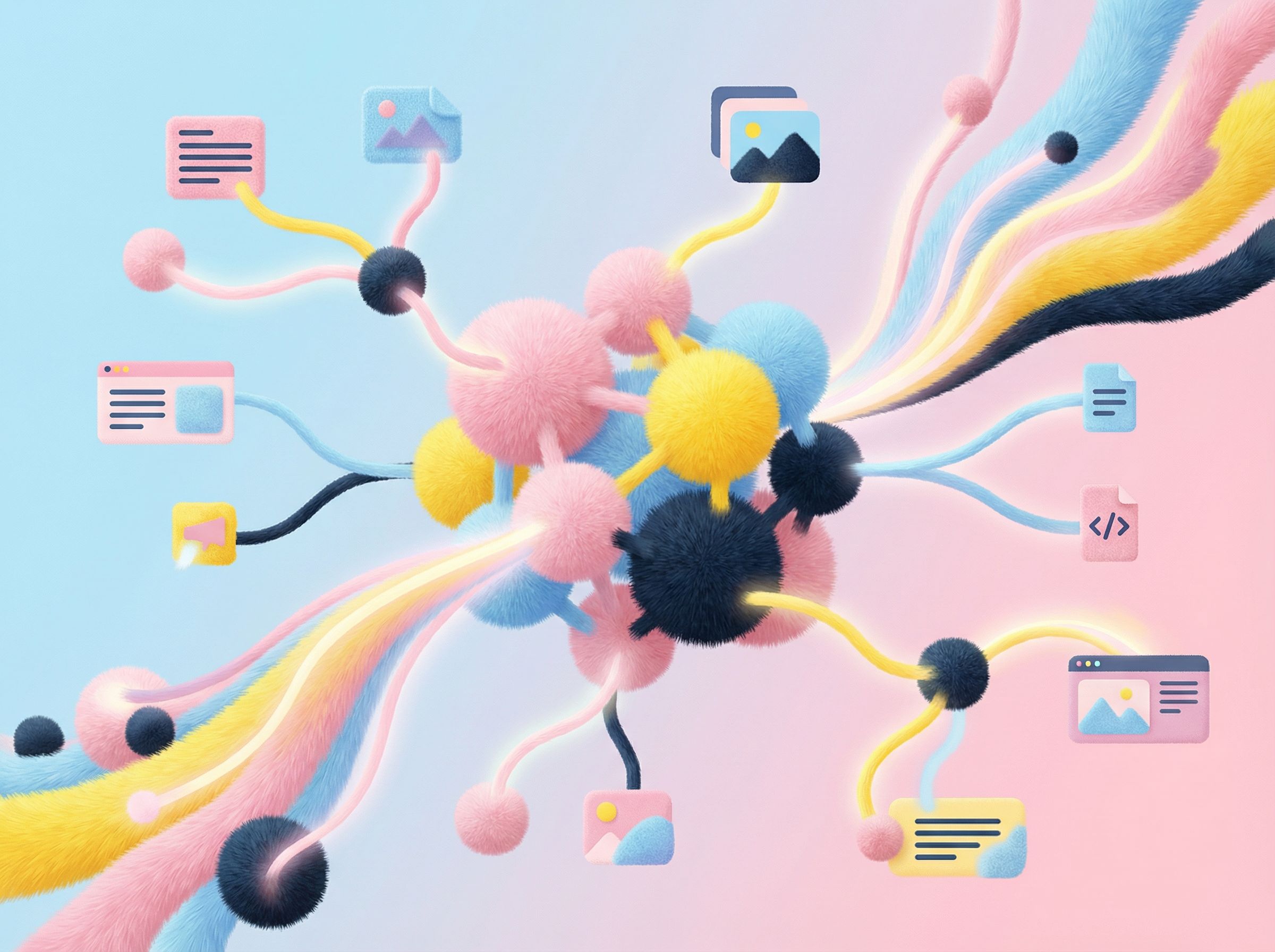
RAG system pipeline: ingest → index → retrieve (securely) → generate (grounded) → evaluate and monitor.
Core concepts for reliable knowledge-based AI
The strongest RAG systems borrow lessons from classic knowledge-based AI: represent knowledge clearly, retrieve evidence, reason with constraints, and validate outputs. Below are the concepts SHAPE uses to make connecting LLMs to private data sources securely work in production.
Explicit knowledge beats “implied memory”
RAG works because it makes knowledge explicit and retrievable. You reduce hallucinations by ensuring the LLM answers from approved evidence—not assumptions.
Representation and indexing choices are product decisions
- Chunking impacts answer completeness and citation quality.
- Metadata impacts permission filters and relevance.
- Refresh cadence impacts correctness for changing policies and procedures.
Reasoning needs constraints (policies, formats, and tools)
In knowledge-based AI, constraints are not a limitation—they’re what makes the system dependable. We implement policy prompts, safe output formats, and (when needed) tool calling through stable APIs.
Evaluation and monitoring are part of the feature
Because knowledge and prompts change, you need a regression loop. We build evaluation sets based on real user questions and track quality trends over time.
Practical rule: If you can’t explain what sources were used, what was retrieved, and why the answer was produced, you can’t safely operate a RAG system.
Use case explanations
Below are high-ROI scenarios where SHAPE builds RAG systems (knowledge-based AI) by connecting LLMs to private data sources securely—with measurable outcomes and strong governance.
1) Internal policy and procedure assistant
Employees ask the same policy questions repeatedly. A RAG system can answer with citations to the exact policy section and restrict responses based on role (e.g., HR vs. non-HR).
2) Support agent assist with ticket history and knowledge base grounding
Agents need fast context: prior tickets, product docs, and known issue playbooks. RAG reduces time spent searching while keeping recommendations grounded in approved sources.
3) Sales and customer success enablement (permission-aware)
Teams can generate account summaries, pull relevant case studies, and answer product questions using internal collateral—without leaking confidential notes across accounts.
4) Compliance and audit preparation
RAG can guide users through required documentation, point to authoritative requirements, and produce structured checklists—while logging sources for auditability.
5) Engineering and operations knowledge search (runbooks + postmortems)
When incidents happen, speed matters. RAG systems can retrieve runbooks, past incident learnings, and service ownership details to reduce time-to-resolution.
Step-by-step tutorial: build and launch a production RAG system
This playbook mirrors how SHAPE ships RAG systems—connecting LLMs to private data sources securely with governance, evaluation, and operational readiness.
- Step 1: Define the workflow, users, and success metrics Pick one high-impact job (policy Q&A, ticket triage, knowledge search). Set measurable targets like answer accuracy, citation correctness, time saved, and escalation rate.
- Step 2: Inventory sources and decide what is “approved” List private sources (docs, tickets, databases). Define which sources are authoritative, how they refresh, and what content must never be retrieved.
- Step 3: Design the security model (permissions + least privilege) Define role-based access rules and how they apply to retrieval. This is the heart of connecting LLMs to private data sources securely.
- Step 4: Build the ingestion pipeline (normalize + enrich metadata) Ingest content, preserve structure, and attach metadata (team, version, sensitivity, product area). Set a refresh cadence so answers stay current.
- Step 5: Implement retrieval (chunking, embeddings, indexing, filters) Choose chunking rules, build an index, and apply metadata constraints. Tune retrieval so the model receives the right evidence—not the most evidence.
- Step 6: Implement generation rules (grounding + citations + format) Write system policies: answer using retrieved sources, cite passages, refuse unsupported claims, and follow structured outputs where helpful.
- Step 7: Add guardrails and safe fallbacks Handle low-confidence retrieval with clarifying questions, retrieval-only summaries, or human escalation. Prevent prompt-injection from retrieved content by enforcing tool and policy boundaries.
- Step 8: Build an evaluation set and regression gates Collect real questions and expected answers (with sources). Track metrics like citation accuracy and policy compliance; block releases on regressions.
- Step 9: Launch in phases with monitoring Roll out to a small group. Monitor retrieval hit rate, latency, costs, and failure modes. Iterate weekly based on logs and user feedback.
Practical tip: The fastest quality improvements come from reviewing “bad answers” weekly and fixing the underlying cause: source gaps, metadata filters, chunking, or evaluation coverage.
Wer sind wir?
Shape unterstützt Unternehmen beim Aufbau interner KI-Workflows zur Optimierung ihrer Geschäftsprozesse. Wenn Sie auf Effizienzsteigerung Wert legen, können wir Ihnen unserer Meinung nach helfen.

Kundenmeinungen
Unsere Kunden lieben die Schnelligkeit und Effizienz, die wir bieten.


Häufig gestellte Fragen
Hier finden Sie Antworten auf Ihre dringendsten Fragen zu unseren Dienstleistungen und zum Dateneigentum.
Alle generierten Daten gehören Ihnen. Wir legen großen Wert auf Ihr Eigentum und Ihre Privatsphäre. Sie können jederzeit darauf zugreifen und sie verwalten.
Absolut! Unsere Lösungen sind so konzipiert, dass sie sich nahtlos in Ihre bestehende Software integrieren lassen. Unabhängig von Ihrer aktuellen Konfiguration finden wir eine kompatible Lösung.
Wir bieten umfassenden Support für einen reibungslosen Ablauf. Unser Team steht Ihnen bei Fragen und Problemen zur Verfügung. Außerdem bieten wir Ihnen Ressourcen, mit denen Sie unsere Tools optimal nutzen können.
Ja, die Personalisierung ist ein zentrales Merkmal unserer Plattform. Sie können die Eigenschaften Ihres Agenten individuell an die Markenbotschaft und Zielgruppe anpassen. Diese Flexibilität steigert die Interaktion und Effektivität.
Wir passen die Preisgestaltung individuell an jedes Unternehmen und dessen Bedürfnisse an. Da unsere Lösungen aus intelligenten, kundenspezifischen Integrationen bestehen, hängen die Endkosten maßgeblich von der gewählten Integrationsstrategie ab.
Alle Dienstleistungen
Finden Sie Lösungen für Ihre drängendsten Probleme.